You Won’t Believe Agadir’s Hidden Architectural Gems
Agadir isn’t just beaches and sunshine—its architecture tells a story of resilience, culture, and unexpected beauty. I was blown away by how much character this Moroccan city holds, from rebuilt modernist buildings to traditional kasbahs perched on hills. If you think it’s just a resort town, think again. The blend of Berber influences, French colonial echoes, and post-1960s reconstruction creates a visual journey you can’t miss. Every street corner reveals a quiet harmony between form and function, tradition and innovation. This is a city that rose from ruins with purpose, shaping a skyline that honors the past while embracing the future. For travelers seeking depth beyond the shore, Agadir’s architectural layers offer a compelling, often overlooked narrative.
The Story Behind the Stone: Agadir’s Architectural Resilience
In 1960, a devastating earthquake reduced much of Agadir to rubble, claiming thousands of lives and erasing centuries of architectural heritage in a matter of minutes. What followed was not merely reconstruction, but a deliberate reimagining of urban life in southern Morocco. The tragedy became a catalyst for one of North Africa’s most thoughtful post-disaster urban planning efforts. Engineers, architects, and city planners worked together to rebuild a city that could withstand future tremors while preserving a sense of cultural identity. This dual mission shaped Agadir’s unique architectural character—functional, forward-thinking, yet deeply rooted in regional aesthetics.
The new city layout prioritized safety through wide boulevards, open plazas, and low-rise construction, minimizing the risk of structural collapse and easing evacuation routes. Reinforced concrete became the foundation of this modern Agadir, but designers avoided sterile uniformity by incorporating local design elements. Terracotta rooftops, arched windows, and shaded walkways were integrated into public buildings and housing projects, softening the modernist lines with warmth and familiarity. The result was a city that felt safe without sacrificing soul—a rare achievement in post-disaster urban renewal.
What makes Agadir’s recovery remarkable is not just its structural success, but its symbolic power. Rebuilding was an act of national pride, a declaration that the community would not be defined by loss. Government buildings constructed in the 1960s, such as the original city hall and municipal offices, were designed with dignity and presence, featuring symmetrical facades and elevated entrances that conveyed stability. These structures were not just shelters; they were statements of resilience. Even today, walking through central Agadir, one senses a quiet confidence in the city’s form—a testament to human determination expressed through brick, beam, and design.
For visitors, understanding this history deepens appreciation for what might otherwise seem like a simple resort town. The city’s layout invites exploration, not just of its sights, but of its spirit. Every plaza, every shaded alley, carries the memory of that fateful night and the decades of careful rebuilding that followed. Agadir stands not as a monument to the past, but as a living example of how architecture can heal, protect, and inspire.
Kasbah Agadir Oufella: Ruins With a View
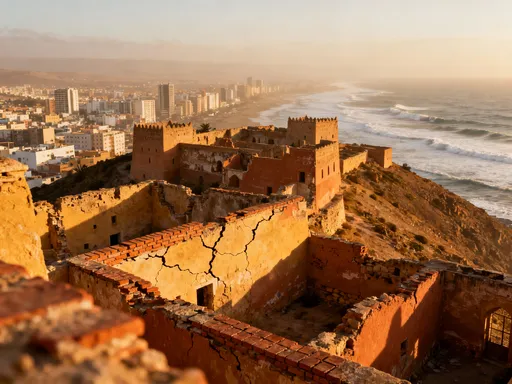
Perched high on a rocky hill overlooking the Atlantic, the remains of Kasbah Agadir Oufella offer one of the most poignant and breathtaking vantage points in the region. Once the fortified heart of the original Berber settlement, this earthen fortress predates the modern city by centuries. Though largely destroyed in the 1960 earthquake, its weathered walls and scattered foundations still speak of its former strength and strategic importance. The climb to the site is modest but meaningful, winding through olive trees and wild herbs, with the ocean gradually unfolding below like a blue tapestry.
Originally built by the Sousi people, the kasbah served as both a defensive stronghold and an administrative center. Its thick rammed-earth walls, constructed using traditional tabia techniques, were designed to withstand both time and attack. From this elevated position, sentries could spot approaching ships or desert caravans long before they reached the coast. The site also housed granaries, living quarters, and a mosque, forming a self-sufficient community at the heart of regional trade. Today, interpretive signs in both Arabic and French help visitors piece together the layout and function of the ancient structures, transforming the ruins into an open-air history lesson.
What truly sets Kasbah Agadir Oufella apart is the view. On a clear day, the panorama stretches from the modern city’s palm-lined boulevards to the endless stretch of Agadir Beach, with fishing boats bobbing near the harbor. To the east, the Anti-Atlas Mountains rise in hazy silhouettes, their rugged forms softened by distance. Sunset is the most magical time to visit—golden light bathes the ruins, and the city below begins to sparkle as evening lights come on. Many locals bring tea or books to enjoy the cool air and quiet atmosphere, making it a favorite spot for reflection as much as sightseeing.
Access to the site is straightforward and welcoming to all ages. A paved path leads from the edge of the old medina, with benches and shaded rest areas along the way. There is no entrance fee, and visitors are free to explore at their own pace. While some may expect a fully restored fortress, the power of the place lies in its authenticity—the sense of standing where history unfolded, undisturbed by excessive tourism. Families, couples, and solo travelers alike find something moving in these silent stones, a quiet reminder of the cycles of rise and ruin that shape human settlements.
Modernist Meets Moroccan: The City’s Post-Earthquake Design Identity
The architectural rebirth of Agadir in the 1960s was guided by modernist principles—clean lines, geometric forms, and functional layouts—yet it never became a faceless concrete grid. Instead, planners and architects made a conscious effort to weave Moroccan identity into the city’s new fabric. This fusion is most evident in the government buildings, schools, and public markets constructed during the reconstruction era. These structures balance earthquake-resistant engineering with cultural expression, creating a style sometimes called ‘Moroccan modernism’—a subtle but powerful blend of European urban planning and North African design sensibilities.
One of the defining features of this era is the use of shaded arcades and covered walkways, known locally as riads or selas. These were not merely decorative but served a practical purpose: protecting pedestrians from the intense midday sun while promoting airflow in narrow urban corridors. The rhythm of repeated arches creates a sense of movement and order, guiding people naturally through commercial and civic zones. In the central market district, these arcades frame small shops and cafés, their whitewashed walls contrasting with dark wooden doors and wrought-iron lanterns that nod to traditional craftsmanship.
Another hallmark of Agadir’s post-quake design is the integration of local materials. While concrete provided structural integrity, it was often finished with stucco textured to resemble traditional earthen walls. Some buildings feature geometric patterns pressed into the plaster, echoing the intricate zellige tilework seen in older Moroccan cities like Fes or Marrakech. Government offices and cultural centers sometimes include courtyards with fountains and orange trees, drawing from the inward-focused design of historic Moroccan homes. These details may go unnoticed at first glance, but together they create a sense of place that feels distinctly Moroccan, not imported.
The city’s layout also reflects a deep understanding of climate and community. Residential neighborhoods were designed with wide streets to allow cross-ventilation, reducing reliance on air conditioning. Green spaces and public fountains were incorporated into neighborhood centers, encouraging social interaction and providing cooling relief. Even the orientation of buildings was carefully considered—many face south or southeast to maximize natural light while minimizing direct sun exposure during the hottest hours. This thoughtful approach to urban living shows how architecture can enhance quality of life without sacrificing beauty or identity.
The Souk El Had Experience: Architecture That Breathes Commerce
No visit to Agadir is complete without stepping into Souk El Had, one of the largest and most vibrant markets in southern Morocco. More than just a place to shop, the souk is an architectural feat in its own right—a vast, covered labyrinth designed to accommodate thousands of visitors daily while maintaining airflow, light, and order. Its high ceilings, supported by rows of sturdy arches, allow hot air to rise, creating a natural ventilation system that keeps the interior several degrees cooler than the outside temperature. This climate-responsive design makes long browsing sessions not only possible but pleasant, even in summer.
The market is organized into distinct zones, each dedicated to a specific type of goods—spices and dried fruits in one wing, textiles and clothing in another, crafts and leatherwork further in. This zoning is not arbitrary; it reflects centuries-old trading traditions while improving navigation for modern shoppers. Arched corridors guide foot traffic in a logical flow, reducing congestion and making it easier to explore without feeling lost. Vendors operate from small, open-fronted stalls, their displays spilling into the walkways in a colorful, lively manner that feels organic rather than chaotic.
Sensory richness defines the experience. The air carries the scent of cumin, saffron, and fresh mint; the sound of haggling blends with the rhythmic tapping of artisans shaping copper pots; sunlight filters through skylights, casting shifting patterns on the tiled floors. These elements are not incidental—they are enhanced by the architecture itself. The use of reflective tiles, the placement of openings for natural light, and the careful acoustics of the vaulted ceilings all contribute to an immersive environment that engages all the senses. It’s a space where commerce, culture, and design coexist in perfect balance.
For families and travelers, Souk El Had offers more than souvenirs—it offers connection. Elderly women in traditional djellabas barter for vegetables, children peer into baskets of dates, and tourists pause to photograph intricate handwoven rugs. The market is a living cross-section of Agadir’s community, and its design supports this social vitality. Unlike sterile shopping malls, this is a place built for human interaction, where every architectural choice—from the height of the ceilings to the width of the aisles—serves the people who use it every day.
Coastal Contrasts: Hotels, Promenades, and the Corniche’s Style
Stretching along the edge of Agadir Bay, the Corniche is where the city meets the sea in a graceful dance of architecture and landscape. This seaside boulevard is lined with hotels, cafés, and public plazas, each contributing to a streetscape that balances tourism with tranquility. Unlike some coastal developments that overwhelm their surroundings, Agadir’s Corniche has largely resisted the temptation of high-rise excess. Most buildings are low to mid-rise, preserving ocean views and minimizing visual clutter. This restraint reflects a growing awareness of environmental sensitivity and the importance of maintaining the natural beauty that draws visitors in the first place.
The architectural style along the Corniche blends contemporary design with regional touches. Many hotels feature terracotta roofs, arched windows, and whitewashed walls that echo traditional Moroccan homes. Rooftop terraces are common, offering guests private spaces to enjoy the sea breeze and sunset views. Public areas include shaded seating, palm trees, and wide pedestrian paths that encourage walking, jogging, or cycling. The result is a promenade that feels inviting and human-scaled, not dominated by traffic or commercial signage.
One of the most successful aspects of the Corniche’s design is its integration of public space. Small plazas with fountains or sculptures break up the linear stretch, providing resting points and gathering spots. Seafront cafés often extend their seating onto the sidewalk, blurring the line between private business and public enjoyment. During the cooler hours of morning and evening, locals and tourists alike stroll the walkway, children play near the sand, and fishermen mend their nets along the breakwater. This vibrant street life is no accident—it is the product of thoughtful urban design that prioritizes accessibility and community.
Newer developments along the Corniche continue to follow these principles, with an increasing emphasis on sustainability. Some modern hotels incorporate solar panels, water-saving fixtures, and green roofs to reduce their environmental footprint. Others use locally sourced stone and wood in their construction, further anchoring them to the region. While luxury is present, it is not flaunted; instead, it is woven into a larger vision of responsible tourism. For travelers, this means enjoying comfort without compromising the integrity of the place they’ve come to experience.
Hidden Courtyards and Local Life: Glimpses Into Residential Neighborhoods
Beyond the main tourist routes, Agadir’s residential neighborhoods reveal a quieter, more intimate side of Moroccan life. These areas, often overlooked by guidebooks, are filled with traditional homes that follow the classic inward-focused design of North African architecture. Exterior walls are plain and unadorned, offering privacy and protection from the sun, but step inside—or even peer through an open doorway—and you’re greeted with a world of color, texture, and tranquility. Tiled courtyards, fragrant jasmine vines, and intricately carved wooden doors hint at the care and craftsmanship that go into everyday living spaces.
The philosophy behind these homes is deeply rooted in family and hospitality. Rooms open onto a central patio, allowing natural light and air to circulate while keeping family life sheltered from public view. This inward orientation reflects cultural values of modesty, privacy, and togetherness. Many homes feature rooftop terraces used in the evenings, where families gather to eat, talk, or simply watch the stars. These spaces are not just functional; they are emotional centers of the household, designed to foster connection and peace.
Travelers can appreciate these neighborhoods respectfully by walking quietly, avoiding intrusive photography, and smiling in greeting. Some guesthouses and cultural tours offer guided visits to traditional homes, providing a rare opportunity to learn about domestic architecture and daily life from local hosts. These experiences go beyond sightseeing—they build understanding. Seeing how a home is arranged, how light enters a room, how a courtyard functions as both garden and living room, offers insights that no museum exhibit can fully convey.
These residential areas also showcase subtle variations in architectural style. In older sections, you’ll find houses with blue-tinted windows and hand-painted shutters, while newer constructions may blend modern materials with traditional forms. Yet the core principles remain: privacy, climate adaptation, and beauty in detail. For the observant traveler, these neighborhoods are a treasure trove of quiet elegance, a reminder that the soul of a city often lies not in its landmarks, but in its ordinary streets.
Design Details That Speak Volumes: From Tilework to Rooftop Terraces
Agadir’s architectural charm often lies in the small details—the kind that might be missed in a hurried tour but linger in memory when noticed. One of the most striking is the use of zellige, the hand-cut mosaic tilework that adorns fountains, door frames, and interior walls. Each piece is carefully shaped and fitted, creating geometric patterns that symbolize infinity and divine order in Islamic art. Though less prevalent than in northern Moroccan cities, zellige still appears in mosques, public buildings, and some private homes, its colors—cobalt blue, emerald green, terracotta red—adding bursts of vibrancy to otherwise neutral façades.
Another detail worth noticing is the carved plaster, or gebs, used to decorate walls and archways. This intricate work involves chiseling wet plaster into floral or arabesque patterns, a skill passed down through generations of artisans. In older buildings, especially around the remnants of the original medina, these carvings show the influence of Andalusian design, with flowing lines and symmetrical balance. Even in modern constructions, simplified versions of these motifs appear, linking the present to the past through ornamentation.
Rooftop terraces are another architectural feature that speaks to both climate and culture. Elevated above the street, these open spaces provide relief from the heat and a private venue for family gatherings. Many are furnished with low tables, cushions, and teapots, ready for evening mint tea under the stars. The flat roofs, common in Moroccan architecture, are practical for drainage and construction, but they also serve as social spaces, reinforcing the importance of family time in daily life. From above, one can see the city’s patchwork of rooftops, satellite dishes, and laundry lines—a candid, unfiltered view of Agadir’s living landscape.
Even window design tells a story. In some older homes, windows are painted a soft blue, a color traditionally believed to ward off insects and evil spirits. Others feature latticework screens, or mashrabiya, that allow ventilation and light while preserving privacy. These elements are not merely decorative; they are solutions born of centuries of adaptation to climate and social norms. For the thoughtful traveler, noticing these details transforms a simple walk into a journey of discovery, revealing the intelligence and artistry embedded in everyday design.
Agadir’s architecture is more than bricks and mortar—it’s a living narrative of survival, identity, and harmony between old and new. By looking beyond the beach, travelers gain a deeper connection to Morocco’s soul. Next time you plan a trip, let design guide your exploration. You might just fall in love with a city you thought you knew.