Lost in the Light: Wandering Athens One Hidden Corner at a Time
Have you ever walked a city just to see where your feet take you? Athens isn’t just about the Acropolis—it’s sun-bleached alleyways, sudden temple ruins between cafés, and golden light that feels like a secret. I wandered with no map and found moments I never expected: a quiet courtyard with 300-year-old olives, a hilltop view at dusk that left me speechless. This is Athens beyond the guidebooks—alive, raw, and absolutely breathtaking.
The Art of Aimless Walking in a Timeless City
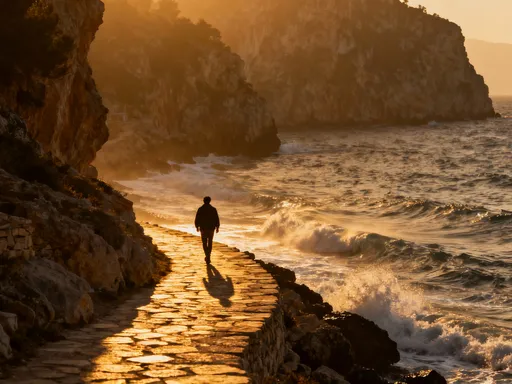
Walking without a destination might seem inefficient, even reckless, in an age of optimized itineraries and GPS precision. Yet in Athens, the act of wandering—truly wandering, without agenda or schedule—becomes a form of discovery unlike any other. The city resists linear navigation; its streets twist, climb, and disappear into courtyards and staircases that lead nowhere on the map but everywhere in the imagination. There is a rhythm to Athenian walking, a slow syncopation between past and present, where every turn can reveal a fragment of history embedded in the modern world.
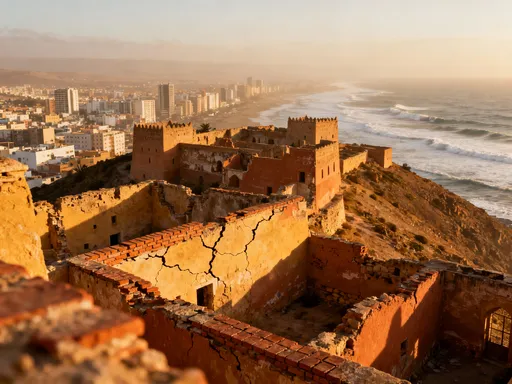
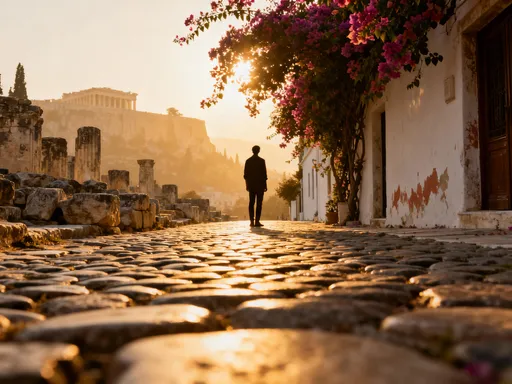
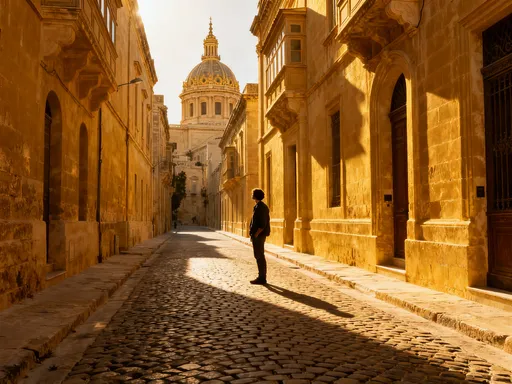
One morning, I turned down a narrow lane near Monastiraki simply because the light was golden and a cat was watching me from a windowsill. Ten minutes later, I stood before a section of the ancient city wall, partially exposed behind a café’s outdoor seating. No sign explained its origin, no fence cordoned it off—just a quiet presence, weathered by centuries, now sharing space with espresso drinkers and stray cats. These moments happen frequently in Athens, not because they are staged, but because they are allowed to exist. The city does not erase its layers; it builds upon them, inviting those who walk slowly to notice.
Experts in urban design often speak of "psychogeography"—the idea that environments shape our emotions and behaviors. In Athens, this is felt most deeply when you surrender to the streets. Without a fixed route, your senses sharpen. You begin to notice the texture of stone, the scent of jasmine after a summer rain, the way sunlight hits a column fragment at 4 p.m. and turns it gold. You hear snippets of conversation in Greek, the clang of a distant tram, the soft strum of a bouzouki from an open window. These details form a narrative richer than any guidebook summary.
Wandering also fosters a kind of humility. You will get lost. You will double back. You will pass the same bakery three times without realizing it. But in that disorientation lies a gift: the chance to see what you weren’t looking for. A 19th-century fountain tucked between apartment buildings, a mosaic step worn smooth by generations, a small shrine with fresh flowers left by a neighbor. These are the city’s quiet offerings, available only to those who move slowly and with openness.
The Acropolis and Its Unexpected Aftermath
No visit to Athens is complete without seeing the Acropolis, but the true journey often begins the moment you step away from it. Most tourists climb the hill at midday, join the queue, take their photos, and descend quickly, unaware that the monument’s power extends far beyond its marble columns. The Acropolis is not just a site—it is a gravitational center, shaping the life of the city around it. To walk its shadow is to understand Athens not as a collection of attractions, but as a living landscape shaped by memory and light.
I visited at sunrise, when the site was nearly empty and the Parthenon glowed in soft pink light. There was a stillness, a reverence, that vanished by 9 a.m. But instead of leaving, I walked down the northern slope, away from the main exit. Here, the path is quieter, lined with wild thyme and oleander. Small staircases branch off, leading to private homes and hidden gardens. From one of these side trails, I found a viewpoint few tourists reach—a rocky outcrop where the Acropolis looms above, unframed by railings or signs, surrounded only by sky and cypress trees.
This perspective changes everything. The monument no longer feels like a museum piece but a part of the city’s breath, its presence woven into daily life. Nearby, elderly men play backgammon in a small square shaded by a plane tree. A woman hangs laundry on her balcony, her clothesline stretching toward the ancient rock. The Acropolis is not separate from Athens; it is embedded in it, a constant companion to those who live below.
For visitors, the lesson is simple: allow time after your visit. Don’t rush to the next attraction. Walk downhill slowly, let the city unfold around you. You might find a small kafeneio where the owner serves loukoumades with honey from his cousin’s hives. You might stumble upon a 5th-century relief carved into a church wall, repurposed during Byzantine times. These are the aftereffects of the Acropolis—not footnotes, but continuations of its story.
Anafiotika: Where Time Forgets to Pass
Just beneath the Acropolis, clinging to the northern slope like ivy to stone, lies Anafiotika—a neighborhood so unexpected, so serene, that it feels like a secret whispered from another century. Built in the 19th century by workers from the island of Anafi, these whitewashed houses with blue doors and red-tiled roofs mimic the architecture of the Cyclades. Narrow staircases wind between walls, bougainvillea spills over terraces, and sunlight filters through grapevines stretched across alleyways. It is, quite simply, the most tranquil place in central Athens.
Walking through Anafiotika is like stepping onto a Aegean island without leaving the city. The sound of traffic fades. The air smells of oregano and warm stone. Cats nap on sunlit steps. There are no souvenir shops, no loud music, no crowds. Just quiet courtyards, small chapels, and the occasional resident tending to potted herbs. One morning, I watched an elderly woman water geraniums in a clay pot, humming a tune I didn’t recognize. She smiled when she saw me, not with the polite acknowledgment of a stranger, but with the warmth of someone who knows her home is beautiful and doesn’t need to explain it.
The history of Anafiotika is modest but meaningful. In the 1830s, King Otto commissioned the construction of his palace, and workers from Anafi were brought to Athens to help with the stonework. They built simple homes for themselves on the rocky slope, using techniques from their island—thick walls, small windows, interior courtyards for cooling. Over time, the neighborhood grew, but its character remained. Even today, it resists modernization. There are no large buildings, no neon signs, no through streets. It exists in a kind of suspended time, protected not by law, but by its own quiet dignity.
For visitors, Anafiotika offers a rare gift: stillness. In a world of constant movement, to stand in a narrow alley and hear only the wind and a distant church bell is a form of luxury. It reminds us that beauty does not always shout. Sometimes it waits in small places, asking only to be noticed. To visit Anafiotika is not to check a box, but to pause, to breathe, to remember that cities can hold pockets of peace.
The Psyrri Paradox: Grit, Graffiti, and Golden Hours
If Anafiotika is Athens’ whisper, Psyrri is its conversation—lively, layered, and full of surprises. Once a working-class neighborhood known for its workshops and tavernas, Psyrri has evolved into a cultural crossroads, where street art covers crumbling walls, independent designers sell handmade goods, and the scent of grilled meat mingles with the sharp tang of spray paint. By day, it feels edgy, even raw. By night, it pulses with music, laughter, and the clink of wine glasses in hidden courtyards.
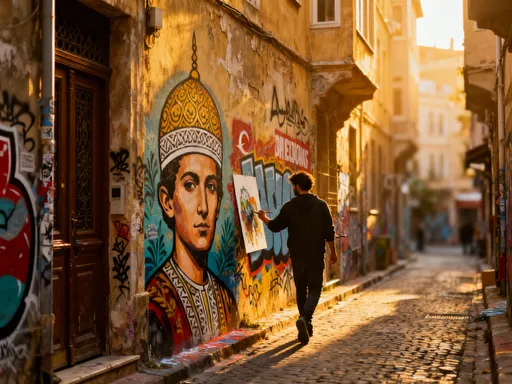
Wandering through Psyrri rewards curiosity. One moment you’re passing a mural of a woman with owl eyes, her face half-covered in geometric patterns. The next, you’re drawn into a small shop where a jeweler shapes silver by hand, his tools arranged like relics on a wooden table. Around the corner, a bakery sells tyropita still warm from the oven, its flaky crust cracking at the touch. These details don’t announce themselves. They reveal themselves slowly, to those who walk without hurry.
I once followed the sound of hammering into a narrow alley and found a metalsmith shaping copper bowls over a small forge. He didn’t speak much English, but he gestured for me to watch. The metal glowed orange, then cooled to a soft rose as he shaped it with precise strikes. When he finished, he held up the bowl, catching the afternoon light. It was imperfect—dented in places, uneven in thickness—but alive with character. He smiled and said, "Zoi," the Greek word for life. In that moment, I understood Psyrri: not polished, not perfect, but full of life.
As dusk falls, the neighborhood transforms. Courtyards open up, revealing small stages where musicians play rebetiko, the soulful music of Athens’ working class. Tavernas fill with locals and visitors alike, sharing meze and stories. The graffiti, so stark in daylight, takes on a different quality under warm lamps—less rebellion, more expression. Psyrri does not hide its contradictions. It embraces them. Here, decay and creativity coexist. History and modernity dance. To walk Psyrri at golden hour is to witness a city in motion, not trying to be anything other than itself.
Philopappos Hill: A Slow Climb with a Soul-Stealing View
Just southwest of the Acropolis, Philopappos Hill rises gently, crowned by a small monument to a Roman benefactor and surrounded by cypress trees, wildflowers, and the occasional sleeping cat. Unlike the steep climb to the Acropolis, this ascent is unhurried, almost meditative. The path winds through shaded groves, past ancient ruins half-buried in ivy, offering glimpses of the city below. It is a walk for those who prefer contemplation to conquest.
The reward comes not all at once, but in layers. First, you see the rooftops of Thissio, their red tiles glowing in the afternoon sun. Then, as you climb higher, the Acropolis appears—not from the front, as in postcards, but from the side, framed by olive trees and stone. By the time you reach the summit, the view is panoramic: the Parthenon bathed in golden light, the Aegean shimmering in the distance, the city spreading out like a living map. And yet, despite the grandeur, the atmosphere remains intimate. Locals walk their dogs, couples sit on benches, children chase butterflies. The view belongs to everyone.
What makes Philopappos special is not just the scenery, but the way it’s experienced. There are no ticket booths, no timed entries, no crowds pressing for photos. You arrive on foot, at your own pace, and the city reveals itself gradually. I once sat for an hour near the summit, watching the light change. At 6:30 p.m., the Parthenon turned amber. By 7:15, it was deep rose. And as the first stars appeared, the city lights blinked on, one by one, like candles being lit. A street musician played a simple melody on a flute, the notes floating on the breeze. No one clapped. No one spoke. We just listened.
For visitors, the lesson is clear: some of the best views come not from the most famous places, but from the ones you discover slowly. Go in the late afternoon. Bring water. Wear comfortable shoes. Let the climb be part of the experience. And when you reach the top, don’t rush. Sit. Breathe. Let the city settle into your memory not as a postcard, but as a feeling.
Kerameikos and the Beauty of Quiet History
Northwest of the city center, along the dry bed of the ancient Eridanos River, lies Kerameikos—a site of profound quiet and understated beauty. Once the potters’ quarter of ancient Athens and later its most important cemetery, Kerameikos is often overlooked by tourists drawn to flashier ruins. But for those willing to walk a little farther, it offers one of the most moving encounters with history in the city.
The site is expansive, yet never feels crowded. Pathways wind between marble stelae, some broken, others intact, carved with images of farewell—children handing toys to their mothers, warriors embracing families, couples holding hands. These are not grand monuments to gods or heroes, but personal memorials, intimate in scale and emotion. Unlike the Acropolis, where history feels monumental, Kerameikos makes it human. You can almost hear the voices, the grief, the love that once filled this place.
The remains of the city walls, the Dipylon Gate, and the Sacred Way add to the sense of walking through layers of time. This was the road along which the Panathenaic procession traveled, where families carried offerings to the Acropolis, where the dead were carried out for burial. To stand here is to touch a thread that connects ancient ritual to modern life. And yet, the site is peaceful, almost garden-like, with wildflowers growing between stones and lizards darting across sun-warmed marble.
Combining a visit to Kerameikos with a walk along the nearby Ilissos Riverbed enhances the experience. Though the river is mostly dry today, the path is shaded by trees and dotted with benches. It’s a place for reflection, for slowing down. I once saw a young woman reading a book beneath an olive tree, her backpack beside her, completely at ease. It was a small moment, but it stayed with me—a reminder that Athens, for all its history, is still lived in, loved, and cherished by those who call it home.
Wandering as a Way of Seeing: Why Athens Rewards the Curious
Athens does not yield its secrets to those who rush. It asks for patience, for presence, for the courage to turn down a street with no name and no destination. The city is not a checklist. It is a conversation—one that unfolds in sunlight on stone, in the laughter from a hidden courtyard, in the way a stranger nods as you pass, as if to say, "You’re seeing it, aren’t you?"
To wander Athens is to practice a different kind of sight. It is to notice not just the grand monuments, but the way a vine grows through a crack in the wall, the way an old man polishes his shoes every morning in the same spot, the way the light changes at 5:47 p.m. and turns the whole city gold. These are the details that stitch the city together, that make it more than a destination, but a feeling.
In a world of curated experiences and algorithm-driven itineraries, aimless walking is a quiet rebellion. It says: I do not need to see everything. I only need to be here, now, open to what the city offers. And Athens, in its layered, sun-drenched wisdom, responds generously. It gives not just views, but moments. Not just history, but life.
So when you come, leave the map in your bag. Let your feet decide. Trust the cat on the windowsill, the scent of jasmine, the pull of a narrow staircase. Let yourself get lost. Because in Athens, getting lost is not a mistake—it is the beginning of seeing.